Waterproof phone: complete guide for emergency environments
A waterproof phone is a communication device designed to resist the penetration of water, dust, and aggressive external agents. In emergency environments, this resistance is not a comfort feature—it is a vital requirement. Whether on an offshore platform, in a tunnel under construction, or at a chemical facility, the failure of a communication terminal can have irreversible consequences.
This article explores the certifications that truly define waterproofing, the environments where these phones are essential, the most common selection errors, and the technical criteria to master before any deployment.
What is a waterproof phone and how is waterproofing measured?
A waterproof phone is defined by its IP (Ingress Protection) rating, an international standard that quantifies a device’s resistance to solids and liquids. This is not a qualitative notion—it is a standardized and verifiable measurement.
The IP rating consists of two digits. The first indicates protection against solids (dust, particles). The second measures resistance to water, from simple splashing to prolonged immersion. A phone rated IP67 withstands immersion at 1 meter for 30 minutes. An IP68 guarantees immersion at greater depth according to conditions defined by the manufacturer.
Decoding the most common IP ratings for emergency phones
In the industrial and security sector, the most frequently encountered ratings are IP65, IP66, IP67, and IP68. Each corresponds to distinct exposure scenarios.
| IP Rating | Dust Protection | Water Protection | Typical Environment |
|---|---|---|---|
| IP65 | Complete | Low-pressure water jets | Food processing industry, sheltered outdoor |
| IP66 | Complete | High-pressure water jets | Quarries, tunnels, industrial washing |
| IP67 | Complete | Temporary immersion (1m / 30min) | Ports, docks, flood zones |
| IP68 | Complete | Prolonged immersion (manufacturer conditions) | Offshore, underwater sites, great depths |
| IP69K | Complete | High-pressure jets at high temperature | Food industry, steam cleaning |
The IP rating alone is not sufficient to characterize a waterproof phone for hazardous environments. Other certifications, notably ATEX for explosive atmospheres, complement the required level of protection.
Emergency environments that require a waterproof phone
In emergency situations, the physical environment degrades equipment far faster than in normal use. A waterproof phone is not a technical luxury: it is the minimum condition to guarantee operational communication under stress.
Oil sites and offshore platforms
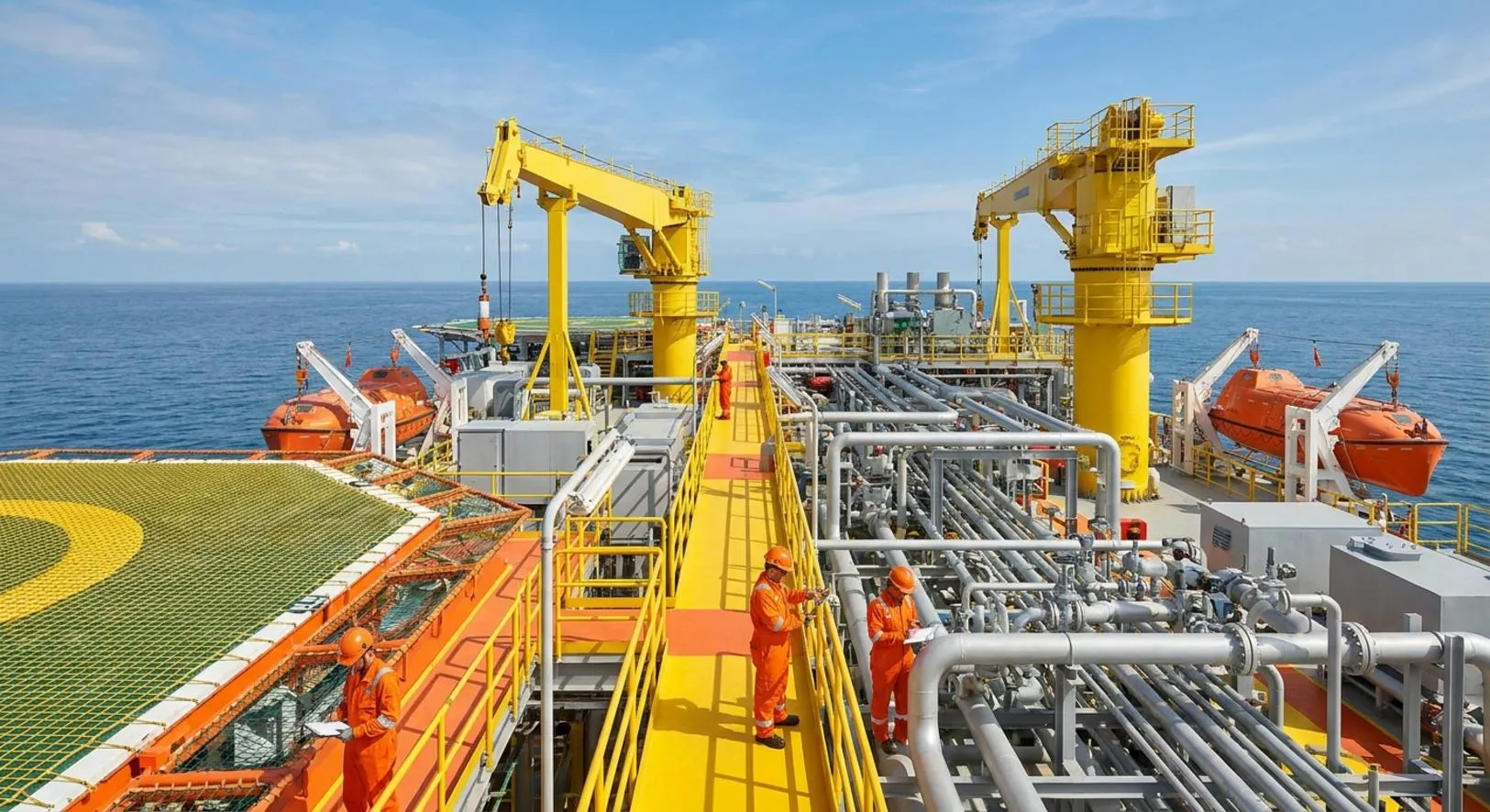
On an offshore platform, seawater is omnipresent: constant spray, splashing during operations, intense condensation in confined spaces. A phone rated IP66 minimum is essential. Salt corrosion attacks connectors and seals within weeks if the equipment is not dimensioned for this environment.
Added to this is the presence of potentially explosive atmospheres. Waterproof phones deployed on these sites must combine IP certification and ATEX certification (or IECEx internationally). These two requirements are inseparable and not substitutable for one another.
Tunnels, mines, and quarries
In underground structures, mineral dust, constant humidity, and water splashing during drilling create a particularly hostile environment. Phones used in road or rail tunnels must withstand high-pressure jets during cleaning operations, hence the relevance of IP66 or IP67 ratings. A2S Voice offers tunnel communication solutions adapted to these specific constraints.
In mines, the presence of firedamp requires dual certification. The waterproof phone must be ATEX certified for zone 1 or zone 2, depending on the probability of an explosive atmosphere. Applicable standards fall under European directive ATEX 2014/34/EU.
Food processing and pharmaceutical facilities
These sectors combine two major constraints: frequent cleaning with hot water or steam, and strict hygiene requirements. An IP69K waterproof phone is sometimes the only acceptable option in a slaughterhouse or pharmaceutical cleanroom. IP certification alone guarantees waterproofing, but resistance to chemical disinfectants must be verified separately in technical data sheets.
Port areas and loading docks
Ports combine marine exposure, mechanical vibrations from cranes and forklifts, and risks of accidental immersion. An IP67 waterproof phone generally corresponds to the minimum requirements for these environments. Fixed emergency stations installed on docks must also resist vandalism and impacts, which points toward robust metal enclosures in addition to IP protection.
Two common errors when choosing a waterproof phone
Choosing a waterproof phone for an industrial or emergency site is rarely trivial, and two errors systematically recur in the field.
Confusing IP and chemical resistance
The IP rating protects against water and dust. It says nothing about resistance to acids, solvents, or aggressive cleaning products. A phone rated IP68 can deteriorate within weeks if its plastic housing is not formulated to resist the chemical agents present on site. This error is common in chemical and pharmaceutical industries where operators select equipment based solely on IP rating without consulting safety data sheets for the products used.
Underestimating the required ATEX level
The second error consists of deploying a non-ATEX certified waterproof phone in a classified zone, or using a zone 2 ATEX certification in a zone 1 area. This confusion creates major risk situations and exposes the operator to criminal liability in case of incident. ATEX zone classification must be performed by a qualified expert before any equipment selection. The mere fact that a device is robust or waterproof does not confer any capability in explosive atmospheres.
ATEX waterproof phone: the superior level for hazardous sites
An ATEX-certified waterproof phone combines two sets of properties that address distinct but often coexisting hazards. Waterproofing protects the device and user against physical agents; ATEX certification guarantees that the device cannot cause ignition in an explosive atmosphere.
European directive ATEX 2014/34/EU classifies hazardous zones according to the frequency and duration of presence of an explosive atmosphere. Zones 0, 1, and 2 concern flammable gases and vapors. Zones 20, 21, and 22 cover combustible dusts. Each zone requires a specific level of protection, designated by the ATEX equipment category (1G, 2G, 3G for gases, 1D, 2D, 3D for dusts).
Selection flowchart for a waterproof phone for ATEX sites
- Identify the presence of flammable gases, vapors, or dusts
- Determine the frequency of explosive atmosphere occurrence
- Classify the zone: 0/1/2 (gas) or 20/21/22 (dust)
- Zone 0 or 20 → category 1 (very high protection)
- Zone 1 or 21 → category 2 minimum
- Zone 2 or 22 → category 3 minimum
- Identify aggressive agents: water, dust, chemicals
- Choose corresponding IP rating: IP65 to IP69K
- High-pressure jet + complete dust → IP66 minimum
- Check for CE ATEX marking on the device
- Verify type examination certificate issued by a notified body
- Review manufacturer’s declaration of conformity
- Follow manufacturer’s installation instructions
- Train personnel in ATEX zone usage
- Schedule periodic inspections of waterproofing and seals
This process is governed by IEC 60079 standards for equipment in explosive gas atmospheres and IEC 61241 for dusts. The French National Institute for Industrial Environment and Risks (INERIS) publishes reference technical guides on ATEX zone classification.
Concrete results: what a properly dimensioned waterproof phone delivers
Properly selected equipment reduces communication incidents, improves response times, and decreases maintenance costs related to premature failures. A typical case observed in the industrial sector concretely illustrates these benefits.
At a chemical processing site equipped with non-ATEX certified and non-waterproof communication stations, maintenance teams recorded an average of 4 to 6 equipment replacements per year, with significant direct costs, not counting periods of vulnerability while the station was out of service. After replacement with IP66 waterproof phones certified ATEX zone 2, the number of maintenance interventions was reduced by over 70% over the following 18 months. Emergency line availability increased from 87% to 99.2% over the same period, a gain directly correlated with the reduction in field incidents related to equipment failures.
This type of result is not exceptional. It reflects what systematically occurs when technical characteristics of equipment are aligned with actual site constraints, rather than relying on generic or undersized equipment.
Does your site require reliable communications in all circumstances? Discover the A2S ATEX hands-free emergency phone range, designed for the most demanding environments.
Limitations and precautions to know before deploying a waterproof phone
A well-chosen waterproof phone is reliable equipment, but it has limitations that every site manager must know before deployment.
Degradation over time of seals
A phone’s waterproofing is not permanent. O-rings and membranes that ensure IP protection age under the effect of UV, thermal variations, and chemicals. A device initially certified IP67 can drop to a significantly lower waterproofing level after two or three years of intensive use without preventive maintenance. Serious manufacturers recommend annual seal inspection and a waterproofing test procedure after any intervention on the device.
Certifications only cover standardized test conditions
An IP rating is validated under precise laboratory conditions. IP67 immersion is tested at 1 meter for 30 minutes in fresh water at ambient temperature. Immersion in salt water, hot water, or at different pressure can produce very different results. This does not mean the device is defective, but that the buyer must ensure test conditions match actual exposure conditions on their site.
Mechanical resistance is not covered by IP rating
A phone can be perfectly waterproof yet prove fragile to impacts, vibrations, or extreme temperatures. IK standards for impact resistance and operating temperature ranges must be verified separately in technical data sheets. On industrial sites, an anodized aluminum or stainless steel housing generally offers far superior mechanical resistance to plastic housings, even high-quality ones.
FAQ: waterproof phone for emergency environments
What is the difference between an IP65 and IP67 waterproof phone?
An IP65 waterproof phone protects against water jets from all directions but does not resist immersion. An IP67 guarantees immersion up to 1 meter for 30 minutes in fresh water. The choice between the two depends on the actual immersion risk on site. In an environment where water runs or splashes without submerging the device, IP65 suffices. If accidental immersion risk exists, IP67 is the minimum required level.
Can a waterproof phone be used in an ATEX zone without specific certification?
No. IP waterproofing confers no capability in explosive atmospheres. A non-ATEX certified waterproof phone can constitute an ignition source in a classified zone. ATEX certification is a distinct regulatory requirement, governed by directive 2014/34/EU, which must be verified independently of IP rating. Both certifications must be present simultaneously for legal and safe deployment in hazardous zones.
How to verify that a waterproof phone retains its properties after installation?
Regular inspection of seals is the first measure to take. Some manufacturers offer pressure test procedures to perform on site without immersing the device. It is recommended to record these inspections in a maintenance log. Any intervention opening the housing must be followed by a waterproofing check before returning to service. The ideal inspection frequency is annual in normal environments, semi-annual in aggressive environments.
Which IP rating to choose for an emergency phone installed outdoors?
A waterproof phone intended for outdoor installation must be rated IP65 minimum to resist weather conditions. If the station is exposed to water jets during cleaning or significant runoff, IP66 is preferable. In port or coastal areas exposed to sea spray, an IP67 combined with salt corrosion resistance constitutes the recommended standard. UV resistance and extreme temperature tolerance must also be verified in technical specifications.
Is a hands-free waterproof phone suitable for industrial emergency interventions?
Yes, and it presents significant operational advantages over a conventional handset. In emergency situations, operators often wear personal protective equipment making handset manipulation difficult. The hands-free function allows immediate communication without contact with the device, which is particularly relevant in chemical environments, fire zones, or confinement situations. Hands-free waterproof phones generally integrate a powerful speaker adapted to noisy environments, with advanced voice quality technologies to guarantee optimal intelligibility.

